
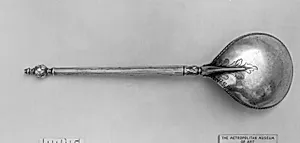
Fruitlet spoon
Unknown Artist
16th–17th century
Medium
Silver gilt
Dimensions
Overall: 7 1/2 × 2 in. (19.1 × 5.1 cm)
Classification
Metalwork-Silver
Culture
possibly German
Department
European Sculpture and Decorative Arts
Museum
Metropolitan Museum of Art, New York, NY
Credit
Rogers Fund, 1913
Accession Number
13.42.152
Rights
Public Domain
Art Historical Context
Nestled in the Metropolitan Museum of Art's European Sculpture and Decorative collection, this delicate *Fruitlet spoon* from 16th or 17th century showcases the refined craftsmanship of possibly German silversmiths. Measuring just 7½ × 2 inches (19.1 × 5.1 cm), its petite scale suggests it was designed for intimate dining pleasures, likely for savoring fruit preserves or confections—a luxury in Renaissance and early Baroque households. Crafted in silver gilt, spoon gleams with a luxurious gold finish applied over silver, a technique that merged the precious metal's malleability with gold's opulent sheen. This fire-gilding process, common in period metalwork, allowed artisans to create intricate forms that withstood daily use while symbolizing wealth and status among Europe's elite. Acquired through the Rogers Fund in 1913, this anonymous masterpiece highlights the era's blend of functionality and artistry in silver objects. It invites visitors to imagine grand banquet tables where such utensils elevated even the simplest indulgences into displays of sophistication and cultural refinement.