
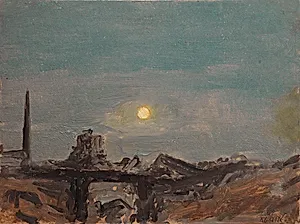
Full Moon Over Luxor Ruins, Off the Nile
February 9, 1876
Medium
Oil on card
Dimensions
17.8 × 24.1 cm (7 1/16 × 9 1/2 in.)
Classification
drawings (visual works)
Department
Prints and Drawings
Museum
Art Institute of Chicago
Accession Number
210191
Rights
Public Domain
Art Historical Context
Lockwood de Forest’s “Full Moon Over Luxorins, Off the Nile captures a luminous moment along Egypt’s ancient riverbank. Painted on February 9,1876, during the artist’s, the small oil sketch records the dramatic silhouette of Luxor’s ruins bathed in moonlight. American landscape painters of the period often journeyed to the Near East, drawn by the region’s dramatic light, monumental architecture, and sense of timelessness. Executed on card rather than canvas, the work reveals de Forest’s practice of carrying portable materials to create on-site studies. This modest support allowed him to respond quickly to changing conditions, preserving the cool radiance of the full moon against warm stone and dark water. The resulting image conveys both the stillness of the night and the vast scale of the ruins seen from the Nile. Though only 17.8 by 24.1 cm, the painting offers an intimate window onto nineteenth-century encounters with Egypt’s past, inviting viewers to share the artist’s quiet awe before these enduring monuments.
About the Artist
Lockwood de Forest · 1850–1932
American painter, interior designer and furniture designer. A key figure in the Aesthetic Movement, he introduced the East Indian craft revival to Gilded Age America. His father was Henry Grant de Forest, and his son worked professionally as Lockwood de Forest, Jr., though the son's birth name is Lockwood de Forest, III.