
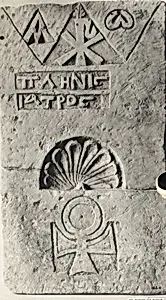
Funerary Stele with Chi-Rho and Alpha and Omega
Unknown Artist
7th–8th century
Medium
Sandstone; carved in relief
Dimensions
H. 18 1/2 in. (47 cm) W. 10 5/8 in. (27 cm)
Classification
Sculpture
Department
Islamic Art
Museum
Metropolitan Museum of Art, New York, NY
Credit
Gift of H. G. Evelyn-White, 1918
Accession Number
18.5.4
Rights
Public Domain
Art Historical Context
This striking funerary stele, carved in low relief from sandstone, served as a tomb marker in the 7th–8th century, a time of profound cultural transition following the Arab conquests. just 18½ inches tall and 10⅝ inches wide, its compact form belies its spiritual depth. At its center dominates the Chi-Rho, an ancient Christogram formed by superimposing the Greek letters chi (Χ) and rho (Ρ)—the first two of "Christos"—symbolizing Jesus as the triumphant savior. Flanking it are the Alpha (Α) and Omega (Ω), the first and last letters of the Greek alphabet, drawn from the Book of Revelation to evoke Christ's eternal nature as "the beginning and the end." Crafted by an unknown artist, likely in a region like Egypt where Christian communities thrived amid rising Islamic rule, the stele exemplifies the endurance of Late Antique Christian iconography. The relief technique, common in durable sandstones of the Near East, allowed for bold, legible symbols that conveyed faith and hope in the afterlife to passersby. Its placement in the Metropolitan Museum's Islamic Art department highlights the intertwined histories of Christianity and Islam, underscoring shared spaces and artistic traditions in the early medieval Mediterranean world. A gift to the Met in 1918 from Egyptologist H.G. Evelyn-White, this artifact invites us to ponder the quiet persistence of belief in eras of change, bridging worlds with quiet eloquence.