
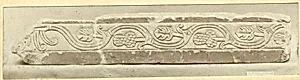
Fragment of a Cornice with Vines
Unknown Artist
3rd–12th century
Medium
Sandstone; carved in relief
Dimensions
H. 8 in. (20.3 cm) W. 49 1/2 in. (125.7 cm) D. 14 1/2 in. (36.8 cm)
Classification
Sculpture
Department
Islamic Art
Museum
Metropolitan Museum of Art, New York, NY
Credit
Rogers Fund, 1910
Accession Number
10.175.1
Rights
Public Domain
Art Historical Context
This exquisite fragment of a cornice, carved from sandstone in low relief, showcases intricate vines twisting across its 49½-inch length, evoking the lush gardens of paradise—a recurring motif in Islamic art. from the 3rd to 12th century, this architectural element likely adorned the upper edge of a mosque, palace or public building in the early Islamic world, where such cornices crowned walls and framed spaces with rhythmic, organic decoration. The modest height of 8 inches and depth of 14½ inches highlight its role as a subtle yet sophisticated accent in grand structures. Crafted by an unknown artist, the piece exemplifies the mastery of stone carving techniques prevalent in regions like Syria, Egypt, or Persia during this expansive period. Sandstone's durability made it ideal for enduring outdoor exposure, while the relief method—chiseling designs to project slightly from the surface—created dynamic shadows and depth, enhancing visual appeal under varying light. Vines, free of human or animal figures, reflect aniconic principles in Islamic aesthetics, symbolizing abundance, fertility, and the divine order of nature. Acquired through the Rogers Fund in 1910 and now in the Metropolitan Museum of Art's Islamic Art Department, this fragment offers a tangible link to medieval craftsmanship, inviting visitors to imagine the vibrant structures it once embellished.