
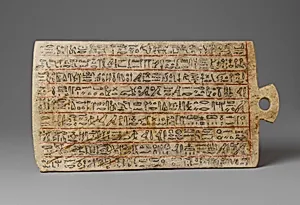
Funerary Tablet of Horpaa, priest at Hermopolis and son of Djehutyhor
Unknown Artist
332–30 B.C.
Medium
Egyptian alabaster (travertine), paint
Dimensions
H. 14 cm (5 1/2 in.); W. 24 cm (9 7/16 in.); D. 0.8 cm (5/16 in.)
Classification
Tablet, funerary, Horpaa
Period
Ptolemaic Period
Department
Egyptian Art
Museum
Metropolitan Museum of Art, New York, NY
Credit
Rogers Fund, 1955
Accession Number
55.144.1
Rights
Public Domain
Tags
Art Historical Context
This delicate funerary tablet honors Horpaa, a priest at Hermopolis—the sacred city of the god Thoth—and son of Djehutyhor. Crafted during Egypt's Ptolemaic Period (332–30 B.C.), when Greek rulers like the Ptolemies governed after Alexander the Great's conquest, it exemplifies the enduring Egyptian traditions blended with Hellenistic influences. Measuring just 14 cm high and 24 cm wide, the shallow-relief slab of translucent Egyptian alabaster (travertine) was likely placed in a tomb as a "false door" for offerings, allowing the ka (spirit) of the deceased to receive sustenance in the afterlife. The tablet's surface bears finely carved hieroglyphs, traces of paint enhancing their vibrancy—a technique prized for its luminous quality in elite memorials. Alabaster, quarried from sites like Hatnub, symbolized purity and was reserved for high-status objects, underscoring Horpaa's prominence in the priesthood. These inscriptions probably detail his titles, family, and prayers for eternal provision, reflecting the Ptolemaic era's continuity of pharaonic religious practices amid cultural fusion. As a window into late Egyptian spirituality, this Rogers Fund acquisition at the Metropolitan Museum of Art reveals how priests like Horpaa bridged old gods and new rulers, ensuring their legacy endured beyond death. A testament to meticulous craftsmanship, it invites us to ponder the hopes etched in stone millennia ago.