
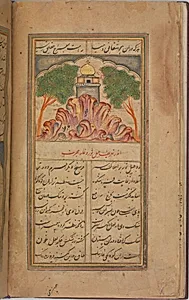
Futuh al-Haramayn (Description of the Holy Cities)
dated A.H. 1089/1678 CE
Medium
Ink, opaque watercolor, and gold on paper
Dimensions
Text block: H. 5 15/16 in. (15.1 cm) W. 3 in. (7.6 cm) Entire page: H. 7 3/8 in. (18.8 cm) W. 4 5/16 in. (11 cm)
Classification
Codices
Department
Islamic Art
Museum
Metropolitan Museum of Art, New York, NY
Credit
Purchase, Funds from various donors, Elizabeth S. Ettinghausen Gift, in memory of Richard Ettinghausen, and Louis E. and Theresa S. Seley Purchase Fund for Islamic Art, 2008
Accession Number
2008.251
Rights
Public Domain
Tags
Art Historical Context
Step into the luminous world of 17th-century Islamic manuscript with *Futuh al-Haram (Description of the Holy)*, crafted by Muhi al-Din Lari in A.H. 1089/1678 CE. This exquisite codex, a bound volume of text on paper, offers a vivid literary pilgrimage to Mecca and Medina, Islam's holiest sites. Produced during the Safavid era in Persia—suggested by the artist's name from Lari, Iran—it reflects the era's devotion to sacred topography and spiritual journeys, blending prose with artistic splendor for pious readers and collectors. The medium of ink, opaque watercolor, and gold on paper elevates this work to a treasured artifact. Calligraphy dominates, with flowing scripts illuminated by vibrant pigments and shimmering gold, a hallmark of Islamic codices that transformed words into visual poetry. These techniques not only preserved religious knowledge but also showcased the scribe's mastery, making the divine tangible. At a compact text block of 15.1 x 7.6 cm, it was designed for intimate study or travel, embodying the portability of faith. Housed in the Metropolitan Museum of Art's Islamic Art department, this piece highlights the cultural prestige of manuscript production, where artistry and piety intertwined. Visitors will appreciate how such works bridged literature and devotion, inviting reflection on the enduring allure of the Haramayn.