
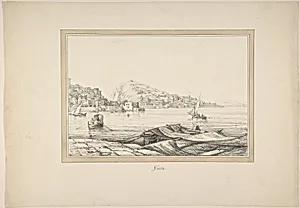
Gaeta
19th century
Medium
Pen and black ink, brush and gray wash. Framing lines in pen and brown ink, brush and brown wash.
Dimensions
sheet: 9 15/16 x 14 3/16 in. (25.3 x 36 cm)
Classification
Drawings
Department
Drawings and Prints
Museum
Metropolitan Museum of Art, New York, NY
Credit
Gift of Mrs. Francis L. Noble, 1935
Accession Number
35.37.1
Rights
Public Domain
Tags
Art Historical Context
Discover the serene landscape drawing *Gaeta*, created by an anonymous French artist the 19th century. Housed in the Metropolitan Museum of Art's Department of Drawings and Prints, work captures the picturesque coastal town of Gaeta, Italy—a historic port known for its dramatic cliffs, medieval castle, and bustling harbor. Tags highlighting landscapes and boats suggest a focus on the area's maritime life, evoking the tranquility of Mediterranean shores with vessels dotting the water. Rendered in pen and black ink with brush and gray wash, the piece employs delicate framing lines in pen and brown ink and brush and brown wash to define its composition on a modest sheet measuring 9 15/16 x 14 3/16 inches. This mixed-media technique, popular among 19th-century French draftsmen, allowed for precise line work to outline forms and subtle washes to convey depth, atmosphere, and the play of light on water—hallmarks of topographical sketches from the Romantic era, when travel and nature inspired artists. A generous gift to the Met from Mrs. Francis L. Noble in 1935, *Gaeta* offers a window into anonymous yet skilled hands documenting Europe's enchanting vistas. It reminds us how such intimate drawings preserved fleeting scenes for posterity, blending technical finesse with evocative storytelling for lovers of maritime art.
About the Artist
Anonymous, French, 19th century · 1800–1900
**Anonymous, French, 19th Century (ca. 1800–1900)** The artist cataloged as Anonymous, French, 19th century embodies the enigmatic yet essential contributions of unidentified creators to France's vibrant 19th-century art world. Active roughly between 1800 and 1900, this figure—or potentially collective workshop—produced a diverse array of works amid the nation's transition from Neoclassicism thro...