
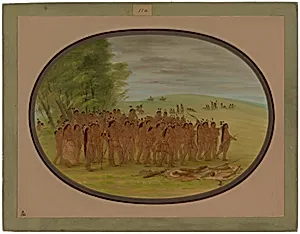
Game of the Arrow - Mandan
1861/1869
Medium
oil on card mounted on paperboard
Dimensions
overall: 47.8 x 63.8 cm (18 13/16 x 25 1/8 in.)
Classification
Painting
Department
CAB
Museum
National Gallery of Art, Washington, D.C.
Credit
Paul Mellon Collection
Accession Number
1965.16.83
Rights
Public Domain
Art Historical Context
George Catlin's *Game of the Arrow -an* (1861/1869) captures a vibrant moment in Mandan Native American life, showcasing a traditional archery game among members of this Upper Missouri River tribe. Painted in oil on card mounted onboard—a compact medium suggesting a study or later reflection from Catlin's vast archive—this 47.8 x 63.8 cm work now graces the National Gallery of Art's Paul Mellon Collection. Cat, a pioneering 19th-century artist and ethnographer, devoted much of his career to documenting Indigenous cultures of the American West before they were irrevocably altered by European-American expansion. Traveling among tribes like the Mandan in the 1830s, he created over 600 paintings that form one of the earliest visual records of their customs, ceremonies, and daily life. This piece highlights the Mandan's skill and communal spirit through their "Game of the Arrow," a contest of precision and athleticism that fostered social bonds. Artistically, Catlin's realistic style blends portraiture with dynamic action, emphasizing authenticity over romantic idealization. His works, including this one produced decades after his fieldwork, remain invaluable for their cultural preservation, offering modern viewers a window into a pre-contact world while underscoring the urgency of his mission to "rescue from oblivion" these endangered traditions.
About the Artist
George Catlin · 1796–1872
George Catlin (1796–1872), born in Wilkes-Barre, Pennsylvania, to Putnam Catlin and Polly Sutton—who had been captured by Native Americans during the 1778 Battle of Wyoming—initially pursued a legal career. Trained at Litchfield Law School, he was admitted to the bar in 1819 but abandoned law after two years to study art in Philadelphia in 1823. Self-taught as a portraitist, Catlin quickly gained ...