
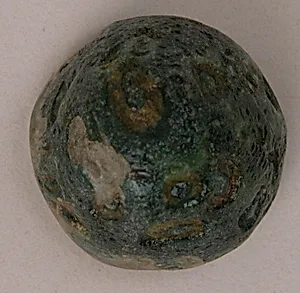
Gaming Piece
Unknown Artist
possibly 8th–12th century
Medium
Glass
Classification
Gaming pieces
Department
Islamic Art
Museum
Metropolitan Museum of Art, New York, NY
Credit
Pfeiffer Fund, 1972
Accession Number
1972.9.18
Rights
Public Domain
Tags
Art Historical Context
This delicate glass gaming piece, dating possibly to the 8th–12th century, hails from the vibrant world of Islamic art. Crafted during a golden age of Islamic civilization under the Abbasid Caliphate and its successors, such objects reveal the everyday leisure pursuits of medieval society. Gaming was a popular pastime, with games resembling backgammon or chess fostering social bonds in courts, homes, and markets across the Islamic world from Spain to Persia. Made of glass—a medium in which Islamic artisans excelled—this piece exemplifies advanced techniques like molding or free-blowing, often yielding translucent, colorful forms. Glass gaming pieces were prized for their affordability yet elegant sheen, blending utility with subtle luxury. Unlike grand ceramics or metals, they highlight the democratization of artistry, making refined objects accessible beyond elites. Today, at the Metropolitan Museum of Art (acquired via the Pfeiffer Fund in 1972), this unassuming artifact invites us to ponder the universal joy of play. It underscores how games transcended cultures, echoing in modern pastimes while preserving a snapshot of Islamic ingenuity and cultural exchange along ancient trade routes.