
Ganesha Transcribing the Mahabharata
Unknown Artist
1878–1883
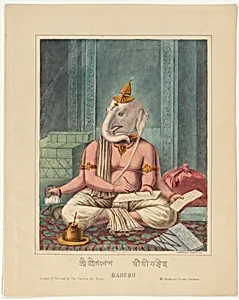
Medium
Lithograph, printed in black and hand-coloring with watercolor and selectively applied glaze
Dimensions
Sheet: 16 × 12 3/4 in. (40.6 × 32.4 cm)
Classification
Prints
Culture
West Bengal, Calcutta
Department
Asian Art
Museum
Metropolitan Museum of Art, New York, NY
Credit
Purchase, Friends of Asian Art Gifts, 2021
Accession Number
2021.205
Rights
Public Domain
Art Historical Context
This vibrant lithograph, *Ganesha Transc the Mahabharata captures a pivotal moment from Hindu mythology: the elephant-headed god Ganesha, of obstacles and patron of arts and letters, diligently scribes the epic *Mahabharata* as dictated by the sage Vyasa. Produced in Calcutta (now Kolkata), West Bengal, 1878 and 1883, it reflects the city's flourishing printmaking scene during British colonial rule, where affordable lithographs brought sacred narratives to homes and temples across India. Printed in black ink on paper and then meticulously hand-colored with watercolor and selective glazes, the medium blends industrial precision with artisanal flair. Lithography enabled mass reproduction of intricate designs, making divine stories accessible to a wider audience, while the added colors and glazes lend a luminous, jewel-like quality reminiscent of traditional paintings. At 16 × 12¾ inches, this intimate sheet exemplifies Calcutta's "Company School" influences, merging European printing techniques with indigenous iconography. Acquired by The Metropolitan Museum of Art in 2021 through the Friends of Asian Art, this print highlights the cultural renaissance of 19th-century Bengal, where art democratized spirituality and preserved epic traditions for generations.