
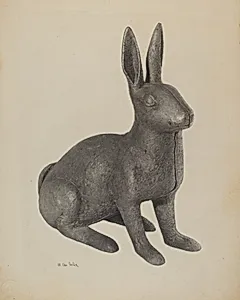
Garden Figure (Rabbit)
c. 1939
Medium
graphite on paperboard
Dimensions
overall: 36.3 x 28.7 cm (14 5/16 x 11 5/16 in.) Original IAD Object: 12 1/8" high; 10 1/4" long
Classification
Index of American Design
Department
CG-W
Museum
National Gallery of Art, Washington, D.C.
Credit
Index of American Design
Accession Number
1943.8.8295
Rights
Public Domain
Art Historical Context
**Garden Figure (Rabbit)** *Graphite on paperboard, c. 1939, by Maurice Van Felix* *National Gallery of Art, Index of American Design* Created around 1939, this delicate graphite drawing on paperboard captures the charming form of a whimsical rabbit garden figure, a beloved staple of American folk art. Measuring 36.3 x 28.7 cm, the artwork meticulously renders an original sculpture standing 12 1/8 inches high 10 1/4 inches long. Maurice Van Felix, working as part of the Index of American—a groundbreaking WPA Federal Art Project from 1935 to 1942—produced this precise study to document and preserve everyday American decorative objects during the Great Depression. The Index employed over 200 artists to create thousands of accurate renderings of folk crafts, highlighting regional traditions and the ingenuity of anonymous makers. Van Felix's graphite technique emphasizes fine lines and subtle shading, bringing the rabbit's playful posture and textured details to life, as if inviting it into a cozy backyard garden. These figures, often carved from wood or cast in concrete, reflected early 20th-century American whimsy, blending utility with delight in outdoor spaces. Today, this piece in the National Gallery of Art celebrates the project's legacy: safeguarding cultural heritage through art, ensuring that humble garden ornaments endure as touchstones of national identity. A delightful nod to simpler times!
About the Artist
Maurice Van Felix
Maurice Van Felix was born on March 16, 1889, in Łódź, Poland, and later became a prominent figure in American art circles after immigrating to the United States. His early training took place in Poland and France, where he honed his skills as a painter and etcher before settling in Brooklyn, New York, by 1919. Though details of his formal education remain sparse, Van Felix quickly established him...