
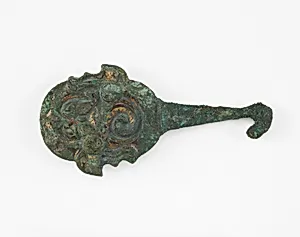
Garment hook (<em>gou</em>)
206 BCE-220 CE
Classification
Jewelry and Ornament
Department
Smithsonian Collection
Museum
Smithsonian American Art Museum
Credit
Gift of Charles Lang Freer
Accession Number
F1915.202
Rights
Public Domain
Tags
About this artwork
To 1915
Art Historical Context
Step into the elegance of Han dynasty China with this exquisite *garment hook*, known as a *gou* (206 BCE–220 CE). Crafted during a golden age of imperial innovation and cultural flourishing, these hooks served as both practical fasteners for flowing silk robes and symbols of refined taste. Worn by the elite, they fastened belts or sashes, blending everyday utility with artistic splendor—a testament to the Han era's mastery of form and function. Forged in bronze through skilled lost-wax casting, this piece features intricate gilding that adds a luxurious golden sheen, evoking the opulence of courtly life. A striking mask motif adorns its surface, echoing ancient Chinese zoomorphic designs that warded off evil spirits and channeled cosmic power. Such ornaments highlight the Han's metallurgical prowess and aesthetic philosophy, where even personal accessories became miniature masterpieces. Generously gifted to the Smithsonian American Art Museum by collector Charles Lang Freer before 1915, this *gou* invites us to admire the enduring legacy of Chinese artistry in the Freer collection. A small object with big stories, it whispers of a dynasty that shaped millennia of innovation.
About the Artist
Unknown
The artist designated as "Unknown" in our virtual museum's collection exemplifies a poignant chapter in art history: creators whose identities have faded into obscurity despite the enduring power of their work. With only one known artwork attributed to them in our holdings, this figure represents countless anonymous hands that shaped visual culture across centuries. Museums worldwide, including th...