
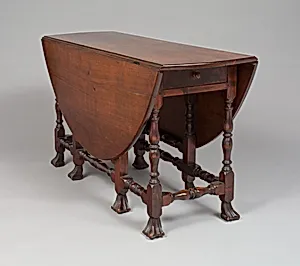
Gate Leg Table
1710–30
Medium
Walnut and pine
Dimensions
Open: 73.3 × 143.5 × 135.5 cm (28 7/8 × 56 1/2 × 53 3/8 in.)
Classification
table
Department
Arts of the Americas
Museum
Art Institute of Chicago
Accession Number
58111
Rights
Public Domain
Art Historical Context
This elegant Gate Leg Table, crafted between 1710 and 1730 exemplifies early 18th-century furniture from the Arts of the Americas at the Art Institute of Chicago Made of rich walnut with pine secondary wood, it measures 733 × 143.5 × 1355 cm when fully open, transforming from a compact console against the into a spacious dining surface swinging out its "gates"—paired drop leaves supported by hinged legs. This ingenious design was ideal for colonial households with limited space, allowing versatility in homes where rooms served multiple purposes. The use of walnut, a durable and beautifully grained hardwood native to eastern North America, highlights the craftsmanship of anonymous colonial woodworkers, likely in regions like New England or the Mid-Atlantic. Pine, lighter and easier to work, was commonly used for interior framing, showcasing practical joinery techniques such as mortise-and-tenon joints that ensured stability. Such tables reflect the influence of English Queen Anne styles adapted to American resources and needs. As a prime example of vernacular furniture, this piece offers a window into everyday colonial life—functional yet refined—reminding us how ordinary objects carried artistic merit and cultural adaptation in a growing New World. Visitors can appreciate its patina, a testament to centuries of use.