
Gateleg table
Unknown Artist
second half 18th century
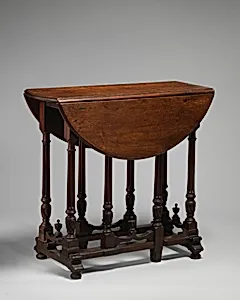
Medium
Walnut
Dimensions
Overall: 27 1/4 × 29 3/4 in. (69.2 × 75.6 cm)
Classification
Woodwork-Furniture
Culture
British
Department
European Sculpture and Decorative Arts
Museum
Metropolitan Museum of Art, New York, NY
Credit
Rogers Fund, 1913
Accession Number
14.12.2
Rights
Public Domain
Art Historical Context
This elegant gateleg table, in the second half of the 18 century by an unknown British artisan, exemplifies the practical ingenuity of Georgian-era furniture. Made from rich walnut—a favored hardwood prized for its durability, warm color, and intricate grain—this piece belongs to the Metropolitan Museum of Art's European and Decorative Arts collection Acquired through the Rogers Fund in 3, it measures 27¼ × 29¾ inches (69.2 × 75.6 cm), compact enough for intimate dining or tea in modest homes. Gateleg tables like this one were a hallmark of British domestic life during the 1700s, featuring hinged leaves supported by swinging "gate" legs that expanded the surface for gatherings and folded away to save space in often cramped urban dwellings. Walnut's use reflects the era's growing access to fine woods via colonial trade, blending functionality with subtle refinement typical of middle-class craftsmanship. No elaborate carving here—just clean lines and solid construction that speak to everyday elegance. Today, this table invites us to appreciate how furniture doubled as art in 18th-century Britain, transforming ordinary routines into moments of grace. A testament to anonymous makers' skill, it reminds visitors of the decorative arts' role in shaping cultural history.