
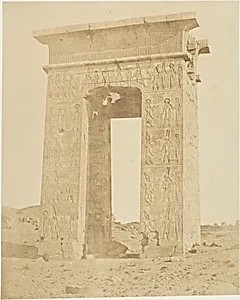
Gate of Ptolemy Philomeder, B.C. 180, Karnac
ca. 1856
Medium
Albumen silver print
Dimensions
Image: 9 1/8 × 7 3/8 in. (23.2 × 18.7 cm) Mount: 16 in. × 12 3/16 in. (40.6 × 31 cm)
Classification
Photographs
Department
Photographs
Museum
Metropolitan Museum of Art, New York, NY
Credit
Robert O. Dougan Collection, Gift of Warner Communications Inc., 1981
Accession Number
1981.1229.49
Rights
Public Domain
Tags
Art Historical Context
Step through time at the Metropolitan Museum of Art with this albumen silver print,Gate of Ptolemy Phileder, B.C. 180, Karnac*, created around 1856 by photographers J. Hogarth and Murray. The image immortalizes a grand pylon gate from the Karnak Temple complex in Luxor, Egypt, built during the reign of Ptolemy VI Philometor (r. 180–145 B.C.). This Ptolemaic-era structure exemplifies the fusion of pharaonic grandeur and Hellenistic influences, with towering walls adorned in hieroglyphs and reliefs celebrating the king's divine rule amid Egypt's transition under Greek Ptolemaic dynasty. Albumen prints, introduced in the 1840s, revolutionized photography with their sharp detail and rich tonal gradations, achieved by coating paper with egg whites and silver salts. Hogarth and Murray, part of the mid-19th-century wave of European photographers documenting Egypt's ancient wonders, captured this gate's weathered majesty just as archaeology fever gripped the West—think Napoleon's savants and early Egyptologists like Champollion. Measuring a modest 9⅛ × 7⅜ inches on its image, yet mounted to stately 16 × 12⅙ inches, it invites intimate study of intricate carvings that whisper tales of gods, pharaohs, and eternity. From the Robert O. Dougan Collection (gift of Warner Communications Inc., 1981), this photograph bridges antiquity and modernity, reminding us how 19th-century lenses preserved imperiled monuments for global audiences. A testament to photography's power as both art and scholarship.
About the Artist
J. Hogarth|Robert Murray ( |British) · |1822 – |1893
|British, Edinburgh 1822–1893 Plymouth