Ctrl K
**Robert Murray (1822–1893)** was a Scottish-born British photographer renowned for his pioneering calotype images of Egypt and the eastern Mediterranean. Born in Edinburgh, he trained and worked as a civil engineer and marine architect. In the early 1850s he spent time in Egypt, where his professional duties led him to document ancient sites through the emerging medium of photography.
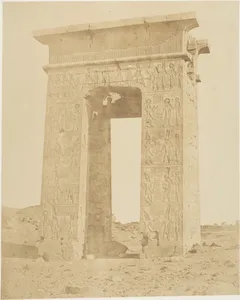
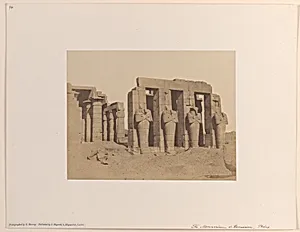
Between 1852 and 1855 Murray produced an extensive series of views in Malta, Alexandria, Cairo, Thebes, and Upper Egypt. He employed the calotype process, creating paper negatives that yielded richly textured prints. His photographs captured monumental architecture such as the Gate of Ptolemy Philomeder at Karnak, the Ramesseum (Memnonium) at Thebes, and the Temple of Abu Simbel. These images were later published in London by J. Hogarth of Haymarket, who issued sets and a catalogue of 163 photographic views.
Murray’s work stands out for its documentary clarity and atmospheric quality, reflecting both the technical challenges of early photography in the field and a sensitive eye for composition. Although he returned to Britain and settled in Plymouth, where he died in 1893, his Egyptian photographs remained relatively obscure for more than a century. Recent scholarship and museum acquisitions have brought renewed attention to his contributions, with examples now held in major collections including the Metropolitan Museum of Art and the Cleveland Museum of Art.
Today Murray is recognized as an important early practitioner whose images provide valuable historical records of ancient monuments and nineteenth-century travel photography. His rediscovery underscores the significance of amateur and professional photographers who helped shape the visual culture of the Victorian era.