
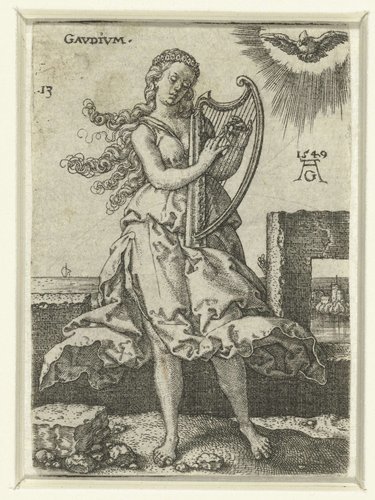
Gaudium
Medium
engraving
Dimensions
70; 49
Rights
Public Domain
About this artwork
gravure
Art Historical Context
**Gaudium** *Heinrich Aldegrever, 1549* *Engraving, 70 × 49 mm* Step into the intricate world of Renaissance printmaking with *Gaudium* (Latin for "Joy"), a of an engraving by Heinrich Aldegre, created in 1549. At just 70mm high 49mm wide, this diminutive work showcases the German artist's mastery of fine detail, a hallmark of the "Little Masters"—engravers who specialized in small-scale masterpieces during the Northern Renaissance. Aldegrever, active in 16th-century Westphalia amid the Protestant Reformation, produced engravings that blended technical precision with allegorical themes. Using a burin to incise lines into a copper plate, he achieved crisp, expressive lines that captured emotion and form in miniature. This technique revolutionized art dissemination, allowing detailed images to reach collectors and scholars far beyond elite patrons. *Gaudium*'s joyful title hints at a personification of delight, reflecting the era's fascination with human virtues and passions. Its portability made it a treasured object, bridging art and everyday life in a time of cultural upheaval. A testament to engraving's enduring power, this piece invites you to marvel at joy etched in metal.
About the Artist
Heinrich Aldegrever · 1502–1561
Heinrich Aldegrever, born in 1502 in Paderborn, Westphalia, to parents Herman and Katherine Trippenmeker—a family of clog-makers known by the dialect name Trippenmecker—emerged as a multifaceted artist in the German Renaissance. His early training remains undocumented, though he likely apprenticed in a Soest goldsmith's workshop after relocating there around 1525, where he joined the painters' gui...