
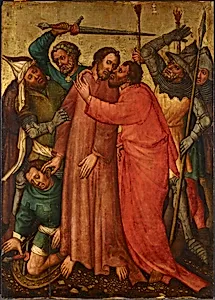
Gefangennahme Christi
um 1445/1450
Medium
Malerei auf Tannenholz
Dimensions
108 × 71,8 × 1,4 cm
Classification
Tafelbild (Flügelretabel)
Department
Belvedere Collection
Museum
Belvedere
Credit
Belvedere, Vienna
Accession Number
4923
Rights
Public Domain
About this artwork
Zugehörige Tafel: Inv.-Nr. 4924
Art Historical Context
**Gefangennahme Christi (The Capture of Christ)**, created around 1445–1450 by the enigmatic Meister des Andreasaltars anonymous Late Gothic master named after a key altarpiece he painted—captures a pivotal moment from the Passion of Christ. This dramatic scene depicts Judas's betrayal and the arrest of Jesus in the Garden of Gsemane, rendered with intense emotion and intricate detail typical of 15th-century Central European art. Likely originating from Austria or southern Germany, it reflects the fervor of the era, when such images served to immerse worshippers in biblical narratives. Painted on fir wood (Tannenholz) in tempera, the 108 × 71.8 cm panel is a wing from a folding altarpiece (Flügelretabel), paired with a related work (Inv.-Nr. 4924) in Vienna's Belvedere Collection. The choice of fir underscores the practical craftsmanship of Gothic workshops, where lightweight woods allowed for portable, ornate church furnishings. The master's style blends meticulous line work, vibrant colors, and gilded elements to heighten spiritual drama, bridging medieval piety with emerging Renaissance naturalism. Housed in the Belvedere, this artwork highlights the anonymous genius behind many surviving altarpieces, offering visitors a window into 15th-century faith and artistry. Its survival as part of a larger ensemble speaks to the enduring cultural role of Passion imagery in fostering empathy and contemplation.