
George and Agnes Engelhard
1907
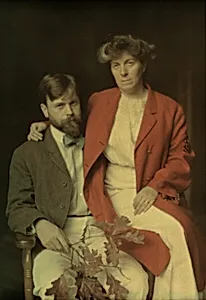
Medium
Autochrome
Dimensions
image: 16.8 × 11.5 cm (6 5/8 × 4 1/2 in.) overall: 17.8 × 12.7 cm (7 × 5 in.)
Classification
Photograph
Department
CPH
Museum
National Gallery of Art, Washington, D.C.
Credit
Robert B. Menschel Fund
Accession Number
2001.33.1
Rights
Public Domain
Art Historical Context
In 1907, pioneering photographer Alfred Stieglitz captured *George and Agnes Engelhard using the groundbreaking Autochrome process, one of the earliest practical methods for color photography. Invented by the Lumière brothers in France and commercially released that same year, Autochrome involved coating glass plates with potato starch grains dyed in red, green, and blue filters, creating luminous, painterly color images through additive color synthesis. This intimate portrait, measuring just 16.8 × 11.5 cm, depicts the couple—likely close acquaintances of Stieglitz—bathed in soft, natural light, evoking a tender domestic moment. Stieglitz, a leader of the Photo-Secession movement and advocate for photography as fine art, embraced Autochrome during his European travels, producing only a handful of these plates before focusing on black-and-white work. The medium's dreamlike hues and subtle textures aligned with Pictorialist ideals, blurring the line between photography and painting. Housed in the National Gallery of Art's collection through the Robert B. Menschel Fund, this rare survival showcases Stieglitz's experimental spirit at a pivotal time when color photography was transforming the medium from documentary tool to artistic expression. Today, *George and Agnes Engelhard* stands as a historical gem, offering visitors a glimpse into early 20th-century innovation and the dawn of color in art photography. Its delicate scale invites close contemplation, revealing the technical marvels that paved the way for modern imaging.
About the Artist
Alfred Stieglitz · 1864–1946
Alfred Stieglitz (1864-1946) was a pioneering American photographer, art dealer, publisher, and advocate for the Modernist movement who was instrumental over his 50-year career in making photography an accepted art form. Born in Hoboken, New Jersey, to German Jewish immigrant parents, Stieglitz spent his formative years studying mechanical engineering in Berlin, where he discovered photography in ...