
George Burns
April 1859
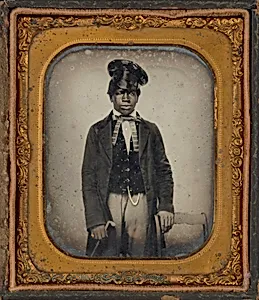
Medium
ambrotype with applied color
Dimensions
image (visible): 6.5 × 5.3 cm (2 9/16 × 2 1/16 in.) mat: 8.2 × 7 cm (3 1/4 × 2 3/4 in.) case: 9.3 × 8.2 × 1.7 cm (3 11/16 × 3 1/4 × 11/16 in.)
Classification
Photograph
Department
CPH
Museum
National Gallery of Art, Washington, D.C.
Credit
Ross J. Kelbaugh Collection, Purchased with support from the Ford Foundation
Accession Number
2023.39.244
Rights
Public Domain
Art Historical Context
Behold the intimate portrait *George Burns*, a gem from April 1859 captured by an anonymous American photographer of the 19th century This ambrotype—a unique positive image on glass—measures a petite 6.5 × 5.3 cm, housed in a protective case just 9.3 × 8.2 cm. Ambrotypes like this one revolutionized photography in the 1850s, offering an affordable alternative to fragile daguerreotypes. By underexposing a wet-collodion negative on glass and backing it with black material, it appeared as a vivid positive, making personal portraits accessible to everyday Americans. What sets this piece apart is the delicate applied color, hand-painted directly onto the image to enhance realism—perhaps tinting cheeks with rosy hues or adding depth to clothing. This technique bridged photography's mechanical precision with the artistry of painting, reflecting mid-19th-century desires for lifelike keepsakes amid rapid social change, from the Gold Rush to pre-Civil War tensions. Now part of the National Gallery of Art's CPH department, acquired through the Ross J. Kelbaugh Collection with Ford Foundation support, *George Burns* invites us to ponder one man's story frozen in time—a poignant reminder of photography's role in preserving identity in an era of transformation. (198 words)
About the Artist
American 19th Century · 1800–1900
The artist cataloged as "American, 19th Century" represents a collective of unidentified painters active in the United States during the nineteenth century, with 380 known artworks preserved in this virtual museum's collection. These works span a diverse array of genres typical of the era, including portraits, landscapes, still lifes, and genre scenes, reflecting the burgeoning artistic output of ...