
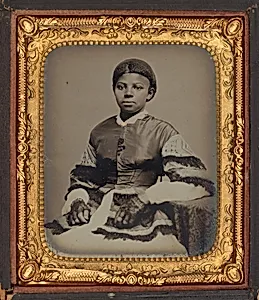
"Remember Me, Annie"
c. 1860
Medium
tintype with applied color
Dimensions
image (visible): 6.5 × 5.2 cm (2 9/16 × 2 1/16 in.) mat: 8.3 × 7 cm (3 1/4 × 2 3/4 in.) case (closed): 9.4 × 8.2 × 2 cm (3 11/16 × 3 1/4 × 13/16 in.)
Classification
Photograph
Department
CPH
Museum
National Gallery of Art, Washington, D.C.
Credit
Ross J. Kelbaugh Collection, Purchased with support from the Ford Foundation
Accession Number
2023.39.34
Rights
Public Domain
Art Historical Context
"Remember Me, Annie" a poignant tintype portrait from around 1860, created by an anonymous American photographer during the mid-19th century This small, intimate image (measuring just 6.5 × 5.2 cm) captures a young woman—presumably Annie—g directly at the viewer, her cheeks and lips enhanced with delicately applied color. Housed in a protective case typical of the era, it exemplifies the tintype process: a direct positive image on a thin iron sheet coated with collodion, prized for its affordability and durability. Tintypes revolutionized photography in Civil War-era America, making professional portraits accessible to everyday people for the first time. Unlike earlier, expensive daguerreotypes, these unique, non-reproducible images were often hand-tinted to add lifelike vibrancy, turning them into cherished keepsakes exchanged between loved ones, soldiers, and sweethearts. The sentimental title, "Remember Me, Annie," evokes the era's culture of remembrance amid separation and uncertainty. Today, this piece from the Ross J. Kelbaugh Collection at the National Gallery of Art highlights vernacular photography's role in preserving personal stories. Its modest scale belies its emotional power, inviting us to ponder Annie's life and the enduring human desire to be remembered.
About the Artist
American 19th Century · 1800–1900
The artist cataloged as "American, 19th Century" represents a collective of unidentified painters active in the United States during the nineteenth century, with 380 known artworks preserved in this virtual museum's collection. These works span a diverse array of genres typical of the era, including portraits, landscapes, still lifes, and genre scenes, reflecting the burgeoning artistic output of ...