
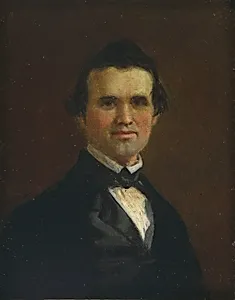
George Caleb Bingham Self-Portrait
Medium
Painting
Classification
Painting
Department
Smithsonian Collection
Museum
Smithsonian American Art Museum
Credit
National Portrait Gallery, Smithsonian Institution Conserved with funds from the Smithsonian Women's Committee
Accession Number
NPG.79.46
Rights
Public Domain
Tags
About this artwork
Eliza K. Thomas Bingham [wife of artist]; her brother William Thomas; his granddaughter Eleanor Cook, Lake Charles, La.; (Hirschl & Adler Galleries, New York); purchased 1979 NPG
Art Historical Context
George Caleb Bingham's Selfrait, created around 1849–50, offers an intimate of the artist during a moment in his career Known primarily as a genre who captured scenes of life along the Missouri and rivers, Bingham here himself in a formal pose, wearing a distinctive bowtie. The painting reflects his dual talents as both a portraitist and a chronicler of the American frontier, rendered in a straightforward, realistic style typical of mid-19th-century American art. Born in Virginia in 1811 and later based in Missouri, Bingham balanced his artistic pursuits with a political career, serving in the state legislature. This self-portrait was passed down through his family before entering the collection of the National Portrait Gallery in 1979. It provides visitors with a rare personal glimpse of the man whose works celebrated the expanding nation and its people. As a painting rather a miniature, the work highlights Bingham's skill in capturing character and setting within an interior space. Its presence in the Smithsonian's holdings underscores his lasting significance as one of America's early visual historians of westward expansion.