
George Reynolds
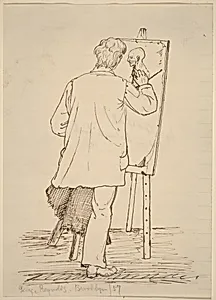
Medium
pen and brown-black ink over graphite
Dimensions
sheet: 17.6 × 12.6 cm (6 15/16 × 4 15/16 in.)
Classification
Drawing
Department
CG-W
Museum
National Gallery of Art, Washington, D.C.
Credit
John Davis Hatch Collection
Accession Number
1979.20.115
Rights
Public Domain
Art Historical Context
In the National Gallery of Art John Davis Hatch Collection resides a delicate portrait drawing titled *George Reynolds*, created in 1859 by John Quincy Ward, one of America's foremost sculptors of the 19th century. Ward, a key figure in the American Renaissance was renowned for his realistic public monuments like the *Indian Hunter* and *Henry Ward Beecher*, blending classical ideals with everyday American vitality. This intimate sheet, measuring just 17.6 × 12.6 cm, captures the sitter in profile, showcasing Ward's early mastery of portraiture during his formative years in New York. Executed in pen and brown-black ink over graphite, the work exemplifies a traditional preparatory technique favored by sculptors. The faint graphite underdrawing allows for precise modeling of form and shadow, refined by fluid ink lines that convey texture and character—skills essential for translating sketches into three-dimensional bronze or marble. Dated to 1859, on the eve of the Civil War, it reflects a moment when American artists like Ward were elevating national identity through portraiture, immortalizing influential figures amid social upheaval. Though modest in scale, *George Reynolds* offers a window into Ward's meticulous process, highlighting how such drawings bridged studio practice and monumental sculpture. Visitors will appreciate its quiet elegance, a testament to the sculptor's eye for human essence.
About the Artist
John Quincy Adams Ward · 1830–1910
John Quincy Adams Ward (1830–1910) was born in Urbana, Ohio, the fourth of eight children, and displayed an early aptitude for three-dimensional form, modeling figures in clay from childhood. In 1849 he moved to Brooklyn, New York, to apprentice under the sculptor Henry Kirke Brown, with whom he worked for seven years. Brown's emphasis on American subjects and his conviction that sculpture should ...