
George Washington
1786/1793
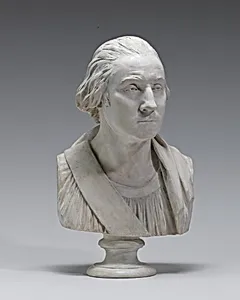
Medium
plaster
Dimensions
overall: 52.6 x 31.5 x 26.3 cm (20 11/16 x 12 3/8 x 10 3/8 in.)
Classification
Sculpture
Department
CSD
Museum
National Gallery of Art, Washington, D.C.
Credit
Gift of Robert L. McNeil, Jr., in Honor of the 50th Anniversary of the National Gallery of Art
Accession Number
1991.199.1
Rights
Public Domain
Art Historical Context
Jean-Antoine Houdon’s plaster bust of George Washington captures the first U.S. president with remarkable presence. Created between 1786 and 1793, the work reflects the close artistic ties between revolutionary America and Enlightenment-era France. Houdon, renowned for his lifelike portraiture, traveled to the United States to study his subject firsthand, translating Washington’s features into a three-dimensional form that conveys both authority and quiet dignity. Plaster was a favored medium for sculptors of the period because it allowed rapid modeling and the creation of multiple casts for distribution. Measuring just over twenty inches high, this intimate scale invites viewers to examine Houdon’s precise handling of surface texture—from the powdered hair to the folds of clothing—revealing the artist’s neoclassical emphasis on clarity and naturalism. Now part of the National Gallery of Art’s collection through a generous gift, the bust serves as a tangible link to the founding era. It reminds visitors how portrait sculpture helped shape public memory of national leaders during the young republic’s earliest decades.
About the Artist
Jean-Antoine Houdon · 1741–1828
Houdon studied under Slodtz, Pigalle, and Lemoyne at the ancienne école académique and at the age of twenty won the Prix de Rome. Three years later, Houdon obtained a residency at the Académie de France in Rome, and in Italy, he discovered the newly uncovered works at Herculaneum and Pompeii as well as works of the Renaissance sculptors, especially Michelangelo. A year after his return to Paris in...