
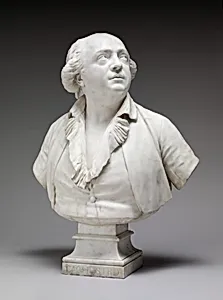
Giuseppe Balsamo, Comte di Cagliostro
Medium
marble
Dimensions
overall without base: 62.9 x 58.9 x 34.3 cm (24 3/4 x 23 3/16 x 13 1/2 in.) gross weight: 285 lb. (129.275 kg)
Classification
Sculpture
Department
CSD
Museum
National Gallery of Art, Washington, D.C.
Credit
Samuel H. Kress Collection
Accession Number
1952.5.103
Rights
Public Domain
Art Historical Context
Jean-Antoine Houdon’s marble bust of Giuseppe Balsamo, Comte di Cagliostro, created in 1786, exemplifies the French sculptor’s mastery of neoclassical portraiture. Houdon was celebrated for his ability to capture both physical likeness and inner character, producing works that feel remarkably alive. Here, the subject—an enigmatic Italian adventurer and self-proclaimed mystic—appears with piercing eyes and a composed, almost theatrical presence, inviting viewers to ponder the man behind the legend. Carved from a single block of marble, the sculpture showcases Houdon’s technical precision in rendering textures such as the soft folds of clothing and the subtle modeling of the face. Marble’s cool luminosity and capacity for fine detail made it the preferred medium for eighteenth-century portrait busts intended to endure as statements of status and intellect. Measuring just under 25 inches in height, the work remains intimate yet commanding, typical of Houdon’s most admired pieces now housed in the National Gallery of Art’s collection.
About the Artist
Jean-Antoine Houdon · 1741–1828
Houdon studied under Slodtz, Pigalle, and Lemoyne at the ancienne école académique and at the age of twenty won the Prix de Rome. Three years later, Houdon obtained a residency at the Académie de France in Rome, and in Italy, he discovered the newly uncovered works at Herculaneum and Pompeii as well as works of the Renaissance sculptors, especially Michelangelo. A year after his return to Paris in...