
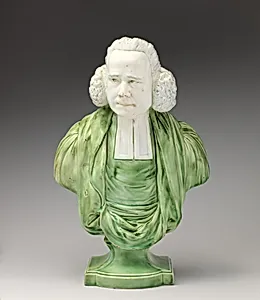
George Whitefield
ca. 1790
Medium
Lead-glazed earthenware
Dimensions
Height: 12 1/2 in. (31.8 cm)
Classification
Ceramics-Pottery
Culture
British, Burslem, Staffordshire
Department
European Sculpture and Decorative Arts
Museum
Metropolitan Museum of Art, New York, NY
Credit
Gift of Francis P. Garvan, 1940
Accession Number
40.171.6
Rights
Public Domain
Tags
Art Historical Context
This charming lead-glazed earthenware bust of George Whitefield, crafted around 1790 by Enoch Wood captures the likeness of one of the 18th century's most influential evangelists. Whitefield, a key figure in the transatlantic Great Awakening, drew massive crowds with his fiery sermons across Britain and America. Standing at 12½ inches tall, this portrait from Burslem, Staffordshire—heart of Britain's pottery industry—exemplifies the era's fascination with celebrity religious leaders, rendered in a medium accessible to middle-class homes. Enoch Wood, a master potter from the renowned Wood family dynasty, specialized in molded ceramic figures that brought historical and contemporary figures to life. Lead glazing gave these earthenware pieces their glossy, vibrant finish, allowing for detailed modeling of Whitefield's expressive face and clerical robes. Staffordshire potters like Wood produced thousands of such "Staffordshire figures," blending mass production with artistic flair to democratize portraiture beyond elite portrait paintings. Housed in the Metropolitan Museum of Art's European Sculpture and Decorative Arts collection, this piece highlights ceramics' role in preserving cultural memory. It invites us to reflect on how everyday objects immortalized the spiritual fervor of the time, bridging art and devotion in Georgian Britain.