
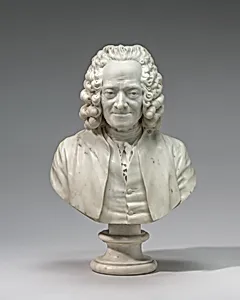
Voltaire
Medium
marble
Dimensions
overall: 52.7 x 45.5 x 33.3 cm (20 3/4 x 17 15/16 x 13 1/8 in.) gross weight: 156 lb. (70.761 kg)
Classification
Sculpture
Department
CSD
Museum
National Gallery of Art, Washington, D.C.
Credit
Widener Collection
Accession Number
1942.9.127
Rights
Public Domain
Art Historical Context
Jean-Antoine Houdon’s marble bust of Voltaire, created in 1778, captures the renowned French philosopher and writer in his later years. As one of the leading sculptors of the Enlightenment era, Houdon specialized in lifelike portrait busts that conveyed both the physical appearance and intellectual spirit of his subjects. This work exemplifies his neoclassical approach, blending classical ideals of harmony with precise observation to immortalize influential thinkers of the time. Voltaire, whose real name was François-Marie Arouet, was a central figure in the Age of Reason, known for his sharp wit and advocacy of civil liberties. Houdon’s choice of marble allows for delicate modeling of the face and drapery, highlighting the subject’s expressive features and thoughtful gaze. The sculpture’s intimate scale invites viewers to connect directly with the man behind the ideas that shaped modern thought. Housed in the National Gallery of Art’s Widener Collection, this bust serves as a tangible link to the Enlightenment’s cultural legacy, reminding visitors of the enduring power of portraiture to preserve history’s most compelling personalities.
About the Artist
Jean-Antoine Houdon · 1741–1828
Houdon studied under Slodtz, Pigalle, and Lemoyne at the ancienne école académique and at the age of twenty won the Prix de Rome. Three years later, Houdon obtained a residency at the Académie de France in Rome, and in Italy, he discovered the newly uncovered works at Herculaneum and Pompeii as well as works of the Renaissance sculptors, especially Michelangelo. A year after his return to Paris in...