
Georgia O'Keeffe—Hands
1919/1920
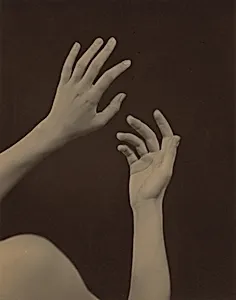
Medium
palladium print
Dimensions
image: 23.2 x 18.2 cm (9 1/8 x 7 3/16 in.) sheet: 24.7 x 20.4 cm (9 3/4 x 8 1/16 in.) mat: 50.8 x 38.2 cm (20 x 15 1/16 in.)
Classification
Photograph
Department
CPH
Museum
National Gallery of Art, Washington, D.C.
Credit
Alfred Stieglitz Collection
Accession Number
1980.70.137
Rights
Public Domain
Art Historical Context
Alfred Stieglitz's *Georgia O'KeeffeHands* (1919/1920) is an intimate palladium print portrait from his renowned series documenting his wife, the modernist painter Georgia O'Keeffe. Captured shortly after their 1918 marriage, this exemplifies Stieglitz's shift toward modernist photography, emphasizing form, texture, and emotional depth over pictorialist softness. As a pioneer in elevating photography to fine art, Stieglitz used these images to celebrate O'Keeffe not just as his muse, but as a powerful creative force, her hands symbolizing dexterity and artistic potential. The palladium print medium—similar to platinum prints but valued for its subtle tonal range and archival stability—lends the 23.2 x 18.2 cm image a luminous, velvety quality that draws viewers into the delicate interplay of light and shadow on O'Keeffe's skin and fingers. Housed in the National Gallery of Art's Alfred Stieglitz Collection, this work reflects the early 20th-century cultural ferment in New York, where Stieglitz's Gallery 291 championed avant-garde artists like O'Keeffe. A testament to personal and artistic synergy, *Georgia O'Keeffe—Hands* invites us to ponder the hands that would paint iconic flowers and skulls, bridging photography's precision with painting's abstraction.
About the Artist
Alfred Stieglitz · 1864–1946
Alfred Stieglitz (1864-1946) was a pioneering American photographer, art dealer, publisher, and advocate for the Modernist movement who was instrumental over his 50-year career in making photography an accepted art form. Born in Hoboken, New Jersey, to German Jewish immigrant parents, Stieglitz spent his formative years studying mechanical engineering in Berlin, where he discovered photography in ...