
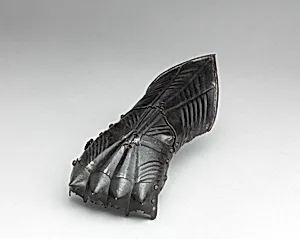
German Gothic Gauntlet for the Left Hand
Unknown Artist
ca. 1480
Medium
Steel
Dimensions
L. 10 3/4 in. (27.31 cm); Wt. 11 oz. (300 g)
Classification
Armor Parts-Gauntlets
Culture
South German or Austrian
Department
Arms and Armor
Museum
Metropolitan Museum of Art, New York, NY
Credit
Gift of William H. Riggs, 1913
Accession Number
14.25.909
Rights
Public Domain
Art Historical Context
Step into the riveting world of late medieval warfare with the *German Gothic Gauntlet for the Left Hand*, crafted around 1480 in South Germany or Austria. This finely wrought steel piece, measuring 10¾ inches long and weighing a mere 11 ounces, protected a knight's hand during jousts, battles, or tournaments. As part of the peak era of plate armor, it exemplifies the Gothic style—known for its elegant, angular forms and intricate riveting that allowed flexibility without sacrificing defense. Armorer's artistry shines in its lightweight construction and precise engineering, essential for wielding swords or lances effectively. South German and Austrian workshops were renowned for such high-quality armor, blending functionality with aesthetic sophistication. This gauntlet, a testament to 15th-century metallurgical skill, would have been custom-fitted to complement a full suit, safeguarding against slashes and thrusts on the battlefield. Today, gifted to the Metropolitan Museum of Art by William H. Riggs in 1913, it invites us to ponder the chivalric age's blend of brutality and beauty. A small but mighty survivor, it highlights how armor evolved from crude chainmail to sculpted steel masterpieces.