
Geweigerde brief
1668 - 1677
Medium
paper
Dimensions
391; 307
Rights
Public Domain
About this artwork
height 391 mm x width 307 mm
Art Historical Context
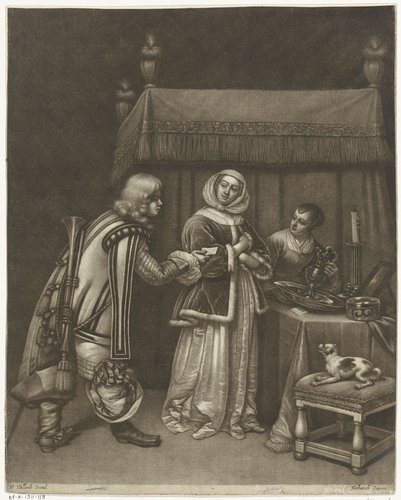
Wallerant Vaillant’s *Geweigerde brief* (used Letter), created between 1668 and1677, is a work on paper measuring 391 mm in height by 307 mm in width As a leading Dutch artist of the 17th century, Vaillant was renowned for his innovations in printmaking during the Golden Age, particularly his pioneering use of mezzotint—a technique he helped develop that allowed for rich tonal gradations and dramatic light effects, earning it the nickname “black manner.” This piece exemplifies Vaillant’s mastery of engraving and chiaroscuro, where contrasting lights and shadows bring emotional depth to everyday scenes. The title evokes a moment of rejection or intrigue, likely depicting a letter returned undelivered, a motif resonant in Dutch genre art that captured intimate human dramas amid the era’s booming postal systems and correspondence culture. Housed in collections today, *Geweigerde brief* highlights Vaillant’s influence on European printmaking, bridging painting and reproduction. Its modest scale invites close contemplation, revealing the artist’s skill in evoking narrative tension on humble paper—a testament to the accessibility and artistry of 17th-century Dutch innovation.
About the Artist
Wallerant Vaillant · 1623–1677
Wallerant Vaillant (1623-1677) was a French-born Dutch Golden Age painter and printmaker who pioneered the mezzotint technique in printmaking. Born in Lille on May 30, 1623, he died in Amsterdam on August 28, 1677, leaving behind a significant legacy as both a portraitist and innovator in graphic arts. Vaillant holds a distinguished place in art history as one of the first professional artists to...