
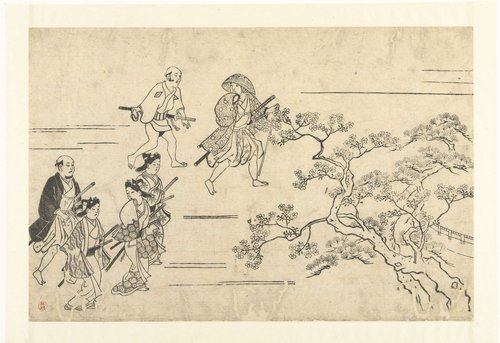
Gezelschap van zes mannen onderweg
1673 - 1677
Medium
paper
Dimensions
387; 256
Rights
Public Domain
About this artwork
inscription
Art Historical Context
Hishikawa Moronobu’s “Gezelschap van zes mannen onderweg” captures a lively group of six men traveling together, rendered on a delicate sheet of paper measuring just 256 by 387 millimeters. Created between 1673 and 1677, the work reflects the early years of ukiyo-e, the “pictures of the floating world” that Moronobu helped establish as Japan’s first great master of the genre. His confident line work and balanced composition bring a sense of movement and camaraderie to the scene, inviting viewers to imagine the conversations and adventures of these travelers on a Japanese road. During the Edo period, images like this one offered city dwellers a window onto journeys they might never take themselves. The presence of an inscription suggests the artist or a later owner wished to record a poem, title, or dedication, adding a personal layer to the print. Though modest in size, the work exemplifies Moronobu’s skill at distilling everyday moments into elegant, enduring images that continue to charm museum visitors today.
About the Artist
Hishikawa Moronobu
Hishikawa Moronobu (1618–1694) holds an unassailable position in Japanese art history as the founder of ukiyo-e, the 'pictures of the floating world' that would become Japan's most internationally recognized art form. Born in the provincial town of Yasuda during the early Edo period, Moronobu transformed woodblock printing from a purely utilitarian craft into an independent artistic medium, establ...