
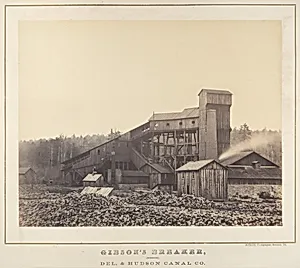
Gibson's Breaker, Rushdale, Pennsylvania
ca. 1865
Medium
Albumen silver print from glass negative
Dimensions
30.3 x 38.7 cm (11 15/16 x 15 1/4 in. )
Classification
Photographs
Department
Photographs
Museum
Metropolitan Museum of Art, New York, NY
Credit
Purchase, Alfred Stieglitz Society Gifts, 2000
Accession Number
2000.124
Rights
Public Domain
Tags
Art Historical Context
Thomas H. Johnson’s “Gibson’s Breaker, Rushdale, Pennsylvania” captures a coal-processing facility in the heart of America’s industrial heart around 1865. large albumen silver, made from a glass negative, reveals the massive wooden structures and towering smokestacks that defined the anthracite region of eastern Pennsylvania. Produced just after the Civil War, the image records the rapid expansion of coal mining that powered the nation’s growing railroads and factories. Albumen prints were the dominant photographic medium of the 1860s, prized for their rich tonal range and fine detail. Johnson’s careful composition emphasizes both the architectural scale of the breaker and its integration into the surrounding landscape, presenting industry not merely as a subject but as a new form of American scenery. The work belongs to the Metropolitan Museum’s collection of early photographs that document the country’s transformation during the Gilded Age. Acquired through gifts from the Alfred Stieglitz Society, the print underscores photography’s emerging role as both historical record and artistic expression. Viewers today can appreciate how Johnson’s image preserves a fleeting moment in the rise of American heavy industry.
About the Artist
Thomas H. Johnson · 1860–1870
Thomas H. Johnson was an American artist active in the latter half of the nineteenth century. Working during a period of considerable vitality in American art — when landscape painting, genre scenes, and printmaking were all flourishing — Johnson contributed to a visual culture that was expanding rapidly alongside the nation itself. The specifics of Johnson's training are not fully documented, th...