
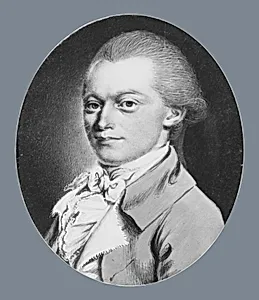
Gilbert Van Cortlandt
ca. 1785
Medium
Watercolor on ivory
Dimensions
Sight: 1 3/4 x 1 3/8 in. (4.5 x 3.5 cm)
Classification
Painting, miniature
Culture
American
Department
The American Wing
Museum
Metropolitan Museum of Art, New York, NY
Credit
Fletcher Fund, 1934
Accession Number
34.131
Rights
Public Domain
Tags
Art Historical Context
Step into the intimate world of 18th-century portraiture *Gilbert Van Cortlandt*, a delicate watercolor miniature on ivory painted around 1785 by John Ram. This tiny gem, measuring just 1 3/4 x 1 3/8 inches, captures the likeness of Gilbert Van Cortlandt, member of one of New York's most prominent colonial families. Housed in The Metropolitan Museum of Art's American Wing, it exemplifies the refined craftsmanship of early American portrait miniatures, acquired through the Fletcher Fund in 4. Ramage, a skilled miniaturist who emigrated from Scotland and established himself in Boston and New York after the Revolutionary War, mastered the challenging technique of layering translucent watercolors on polished ivory. This medium allowed for luminous skin tones, intricate details in lace and fabrics, and a lifelike gaze that feels remarkably personal despite the scale. Miniatures like this were cherished keepsakes—often worn as lockets or brooches—serving as portable mementos for loved ones separated by travel or war. In the post-Revolutionary era, such portraits symbolized emerging American identity, blending European traditions with a new national pride. Van Cortlandt's image reflects the elite's desire for sophisticated self-presentation, offering visitors a window into the elegance and resilience of late 18th-century society.
About the Artist
John Ramage · 1748–1842
Ireland ca. 1748–1802 Montreal