
Girandole
1850–60
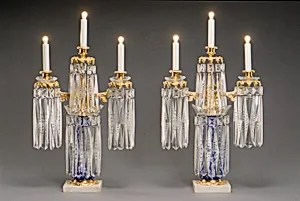
Medium
Cased and cut blown and engraved glass, marble
Dimensions
H. 21 3/4 in. (55.2 cm); Diam. 8 in. (20.3 cm)
Classification
Girandole
Culture
American
Department
The American Wing
Museum
Metropolitan Museum of Art, New York, NY
Credit
Friends of the American Wing Fund, 1982
Accession Number
1982.215.1
Rights
Public Domain
Art Historical Context
Nestled in the opulent parlors of mid-19th-century American homes, this *Girandole* from the New England Glass Company (active 1818–1888) exemplifies the era's fascination with lavish decorative lighting. Dating to 1850–60, this wall-mounted sconce stands 21¾ inches tall with an 8-inch diameter, featuring branching arms likely designed to hold candles, its marble base providing sturdy elegance. Produced in Cambridge, Massachusetts, by one of America's premier glassworks, it reflects the growing confidence of U.S. manufacturers in rivaling European imports during the Victorian period. The artwork's medium—cased and cut blown and engraved glass combined with marble—highlights sophisticated techniques. Blown glass forms the fluid, luminous body, while casing sandwiches layers of colored glass for depth and brilliance. Intricate cutting and engraving create sparkling facets and detailed motifs, catching candlelight to dramatic effect. These methods, perfected by New England artisans, transformed functional objects into sculptural jewels. Acquired in 1982 through the Friends of the American Wing Fund, this piece graces The Metropolitan Museum of Art's American Wing, underscoring the cultural importance of domestic luxury goods. It invites visitors to envision gaslit evenings in prosperous households, where such girandoles illuminated social gatherings and symbolized refined taste.
About the Artist
New England Glass Company · 1818–1888
**The New England Glass Company: Pioneers of American Flint Glass** The New England Glass Company was established on February 16, 1818, in East Cambridge, Massachusetts, by a quartet of prominent local businessmen: Amos Binney, Edmund Munroe, Daniel Hastings, and Deming Jarves. Jarves, drawing on his dry goods background and talent for recruiting Europe's finest cutters, served as operational man...