
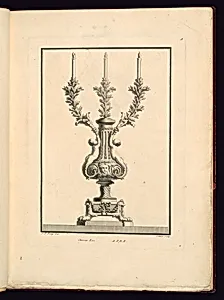
Girandole (Candelabra) Design
Medium
Classification
Department
Smithsonian Collection
Museum
Smithsonian American Art Museum
Credit
Purchased for the Museum by the Advisory Council
Accession Number
1921-6-310-3
Rights
Public Domain
About this artwork
Research in Progress
Art Historical Context
This elegant *Girandole (Candelabra) Design* by Jean François Forty, active from 1775 to 1790, dates to 1775–94 and exemplifies the refined ornamental prints of the late 18th century. As a print in the Smithsonian American Art Museum's collection—purchased by the Advisory Council—it captures a proposed design for a girandole, a luxurious wall-mounted candelabra with branching arms for multiple candles. These fixtures were prized in grand European and American interiors, blending functionality with opulent decoration to illuminate lavish spaces during evening gatherings. Printed designs like this one played a crucial role in the dissemination of fashionable motifs across workshops and homes. Forty's work reflects the neoclassical tastes of the period, where symmetry, scrolling motifs, and gilded accents evoked antiquity while serving modern elegance. Such prints allowed artisans— from silversmiths to cabinetmakers—to replicate high-style furnishings affordably, influencing transatlantic decorative arts amid growing trade between Europe and the Americas. Though research on this piece is ongoing, it offers a window into how visual ideas traveled via paper, shaping the aesthetic of the early American republic. Visitors can appreciate its delicate lines as a testament to the era's blend of artistry and practicality.