
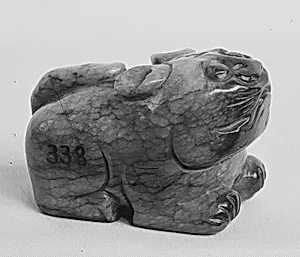
Girdle appendage
Unknown Artist
ca. 13th century
Medium
Nephrite
Dimensions
H. 2 in. (5.1 cm); W. 1 5/16 in. (3.4 cm); L. 1 1/4 in. (3.1 cm)
Classification
Jade
Culture
China
Department
Asian Art
Museum
Metropolitan Museum of Art, New York, NY
Credit
Gift of Heber R. Bishop, 1902
Accession Number
02.18.338
Rights
Public Domain
Tags
Art Historical Context
This exquisite *Girdle appendage*, carved from nephrite jade around the 13th century hails from China and exemplifies the pinnacle of Song or early Yuan dynasty craftsmanship. Measuring just over 2 inches high, this petite ornament (H. 2 in.; W. 1 5/16 in.; L. 1 1/4 in.) was designed to adorn a belt or girdle, a common accessory for elite men and women. Nephrite, prized for its toughness, creamy translucency, and subtle green hues, allowed artisans to achieve remarkable detail on such a small scale, showcasing the advanced piercing, incising, and polishing techniques honed over centuries in Chinese jade workshops. The piece likely features rabbits—a motif evoking the Jade Rabbit of Chinese mythology, who pounds the elixir of immortality on the moon, symbolizing longevity and prosperity. Rabbits also tied into lunar cycles and fertility, making them auspicious for personal adornments. As a status symbol, girdle pendants like this jingled softly with movement, signaling wealth and refinement; jade's association with purity and virtue further elevated their cultural prestige. Today, this gift to the Metropolitan Museum of Art from Heber R. Bishop in 1902 invites us to marvel at China's enduring jade tradition, where everyday luxury met profound symbolism in the hands of anonymous masters.