
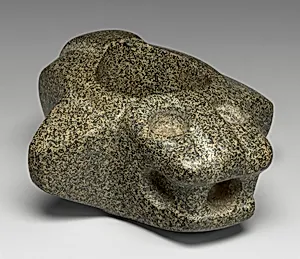
Stone Animal Mace Head
Unknown Artist
1st–5th century
Medium
Stone
Dimensions
H. 3 7/16 x W. 3 x D. 1 3/4 in. (8.8 x 7.6 x 4.5 cm)
Classification
Stone-Implements
Culture
Guanacaste-Nicoya
Department
Arts of Africa, Oceania, and the Americas
Museum
Metropolitan Museum of Art, New York, NY
Credit
The Michael C. Rockefeller Memorial Collection, Bequest of Nelson A. Rockefeller, 1979
Accession Number
1979.206.767
Rights
Public Domain
Art Historical Context
Behold the **Stone Animal Mace Head**, a captivating artifact from the Guanacaste-Nicoya culture of Costa Rica, dating to the 1st–5th century CE. Carved from stone into the form of a fierce animal—likely evoking the power of jungle beasts—this compact object measures just 3 7/16 x 3 x 1 3/4 inches, fitting snugly in the hand. Part of the Metropolitan Museum of Art's Arts of Africa, Oceania, and the Americas collection, it entered through The Michael C. Rockefeller Memorial Collection in 1979. In pre-Columbian Central America, mace heads like this served dual purposes: as functional weapons hafted to wooden handles for battle, and as symbols of status and spiritual authority. The Guanacaste-Nicoya peoples, renowned for their intricate stonework, imbued these implements with zoomorphic vitality, blending utility with ritual significance. The smooth carving highlights masterful control of hard stone, transforming raw material into a potent emblem of elite warriors or shamans. This piece offers a window into early Costa Rican societies, where animal forms bridged the human and natural worlds, underscoring themes of strength and protection. A testament to ancient ingenuity, it reminds us how everyday tools evolved into enduring art.