
Girdle buckle
Unknown Artist
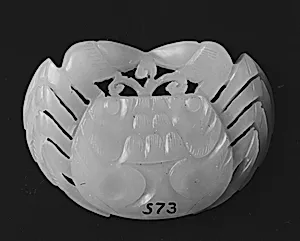
Medium
Nephrite, white with faint grayish tint
Dimensions
H. 1 5/16 in. (3.4 cm); W. 1 15/16 in. (4.9 cm); D. 5/16 in. (0.8 cm)
Classification
Jade
Culture & Period
China · Qing dynasty (1644–1911), Qianlong period (1736–95)
Department
Asian Art
Museum
Metropolitan Museum of Art, New York, NY
Credit
Gift of Heber R. Bishop, 1902
Accession Number
02.18.573
Rights
Public Domain
Art Historical Context
This delicate girdle buckle, crafted from nephrite jade with its signature white hue and faint gray tint, hails from China's Qing dynasty during the Qianlong period (6–95). Measuring just 1 5/16 inches high and 1 15/16 inches wide, it the era's mastery of jade carving, a medium revered in Chinese culture for over 7,000 years. Neph, tougher than silk yet carved to jewel-like precision, symbolized purity, immortality, and imperial virtue—qualities prized by the Qianlong emperor, a passionate patron of the arts who amassed vast jade collections. Girdle buckles like this were essential accessories for elite men, securing the wide belts of official robes and denoting status in Confucian bureaucracy. The Qianlong court's workshops in Beijing elevated jade artistry to new heights, blending archaic motifs with innovative techniques like incising and polishing to achieve a luminous translucency. Though the artist's identity remains unknown, the buckle's refined form reflects the period's opulent aesthetic, bridging utility and splendor. Today, this treasure resides in the Metropolitan Museum of Art's Asian Art department, a gift from Heber R. Bishop in 1902, inviting us to appreciate the enduring elegance of imperial China.