
Girl with Bowl
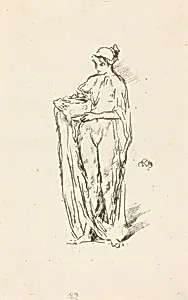
Medium
lithograph in black on laid paper
Dimensions
image: 13.6 × 6.7 cm (5 3/8 × 2 5/8 in.) sheet: 22.2 × 16.4 cm (8 3/4 × 6 7/16 in.)
Classification
Department
CG-W
Museum
National Gallery of Art, Washington, D.C.
Credit
Rosenwald Collection
Accession Number
1943.3.8740
Rights
Public Domain
Art Historical Context
**Girl with Bowl**, a delicate lithograph created by James McNeill Whistler in 5, captures the artist's mastery of subtlety and harmony. Whistler, the renowned American-born painter and printmaker who championed the Aesthetic movement, favored "art for art's," prioritizing tonal balance and evocative mood over narrative detail. This intimate work, measuring just 136 × 6.7 cm in its image area, depicts a simple subject—a girl holding a bowl—rendered in black ink on laid paper, whose textured surface adds a tactile, historical charm reminiscent of 19th-century printmaking traditions. Lithography, Whistler's preferred medium here, allowed him to draw fluidly on lithographic stone with greasy crayon, transferring intricate lines and subtle tones through ink and dampened paper. By 1895, late in his career, Whistler had refined this technique in series like his Venice etchings and Thames views, producing affordable prints that democratized his vision for broader audiences. The modest scale and monochrome palette emphasize line quality and form, evoking quiet elegance amid the era's industrialization. Housed in the National Gallery of Art's Rosenwald Collection, this print exemplifies Whistler's enduring influence on modern graphic arts, bridging fine art and reproduction. Visitors will appreciate its poetic restraint—a timeless snapshot of everyday grace preserved in the CG-W Department.
About the Artist
James McNeill Whistler · 1834–1903
James Abbott McNeill Whistler (1834-1903) was an American-born painter and printmaker who became a leading figure in the Aesthetic Movement and pioneer of Tonalism and Japonisme. He revolutionized art by championing "art for art's sake" and treating paintings as visual equivalents of musical compositions, titling works as "arrangements," "harmonies," and "nocturnes" to emphasize formal qualities o...