
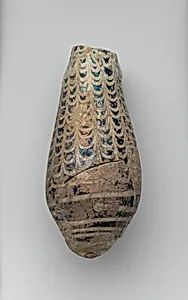
Glass alabastron
Unknown Artist
2nd–1st century BCE
Medium
Glass
Dimensions
H. 3 3/4 × Dia. 1 11/16 in. (9.5 × 4.3 cm)
Classification
Glass
Culture & Period
Greek · Late Hellenistic
Department
Greek and Roman Art
Museum
Metropolitan Museum of Art, New York, NY
Credit
The Cesnola Collection, Purchased by subscription, 1874–76
Accession Number
74.51.6716
Rights
Public Domain
Art Historical Context
This delicate glass alabastron, to the Late Hellenistic period (2nd–1st century BCE), exemplifies the craftsmanship of ancient Greek artisans. Standing just 3 3/4 inches tall a slender, bulbous body and narrow neck, it served as a container for precious oils, perfumes, or cosmetics—essentials in daily life and ritual practices. Produced in the vibrant cultural milieu of the Hellenistic world, where Greek influence spread across the Mediterranean after Alexander the Great, such vessels were both functional and luxurious, often used by women in grooming rituals or as grave offerings. Crafted from translucent glass, the alabastron highlights the technical prowess of pre-Roman glassmakers, who likely employed core-forming techniques: wrapping molten glass threads around a removable core of sand or clay. This method allowed for intricate shapes and subtle color variations, though this example's simplicity underscores the era's shift toward elegant minimalism. As part of the Cesnola Collection at The Metropolitan Museum of Art—acquired through public subscription in 1874–76—it offers a tangible link to everyday Hellenistic life, bridging the gap between elite art and personal devotion. Today, this unassuming yet elegant piece invites us to imagine the scented world of ancient Greece, where beauty and utility intertwined seamlessly.