
Glass Button Hook
c. 1938
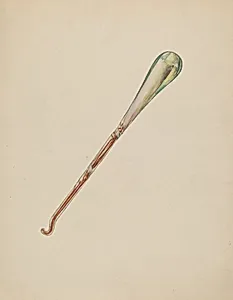
Medium
watercolor and graphite on paperboard
Dimensions
overall: 27.1 x 22.5 cm (10 11/16 x 8 7/8 in.)
Classification
Index of American Design
Department
CG-W
Museum
National Gallery of Art, Washington, D.C.
Credit
Index of American Design
Accession Number
1943.8.10860
Rights
Public Domain
Art Historical Context
Welcome to the National Gallery of's showcase of the Index of American! *Glass Button Hook* (c. 1938) by Francis Law Durand captures a delicate Victorian-era tool in exquisite detail. This watercolor and graphite rendering on paperboard depicts a slender glass button hook, once essential for fastening tight buttons on gloves, shoes, and garments before zippers became commonplace. Measuring 27.1 x 22.5 cm, it exemplifies the precision of Durand's hand, blending soft washes of watercolor to evoke the object's translucent sheen with fine graphite lines for sharp contours. Created as part of the Federal Art Project under the Works Progress Administration (WPA) during the Great Depression, the Index of American Design (1935–1942) employed artists like Durand to document everyday American folk and decorative arts. These index-card-style illustrations preserved cultural artifacts threatened by time or obsolescence, creating a visual archive of national heritage. Durand's piece highlights the humble beauty of functional glassware, reflecting 19th-century craftsmanship and the era's ingenuity. Through its meticulous technique—watercolor for luminous color and graphite for technical accuracy—this work not only revives a forgotten accessory but also celebrates American design ingenuity, inviting us to appreciate the artistry in the ordinary.
About the Artist
Francis Law Durand · 1855–present
**Francis Law Durand (1906–1995)** Born on March 31, 1906, in Mount Holly, New Jersey, Francis Law Durand emerged as a skilled American draftsman and artist during the Great Depression era. Little is known about his early life or formal training, as biographical details remain sparsely documented beyond his professional output. By 1935, he was employed by the Works Progress Administration (WPA), ...