
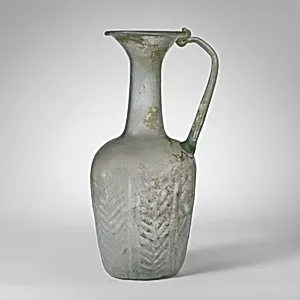
Glass hexagonal jug
Unknown Artist
6th to early 7th century CE
Medium
Glass
Dimensions
H. 8 1/4 in. (21 cm)
Classification
Glass
Culture & Period
Roman, Syrian · Early Byzantine
Department
Greek and Roman Art
Museum
Metropolitan Museum of Art, New York, NY
Credit
Museum Accession
Accession Number
X.21.152
Rights
Public Domain
Art Historical Context
This delicate **Glass Hexagonal Jug**, crafted by an unknown artist in the th to early 7th century CE, hails from Roman Syria during the Early Byzantine period. at 8 1/4 inches (21 cm) tall, it in the Metropolitan Museum of's Greek and Roman Art. Its faceted hexagonal shape—uncommon yet elegant—suggests it was designed for both practicality and visual appeal, likely as a table vessel for pouring wine or water in affluent households. Glassmaking flourished in Syria under Byzantine influence, building on Roman traditions of free-blowing techniques that allowed artisans to create thin-walled, precisely shaped forms without molds. This jug's transparent medium highlights the era's mastery of clear glass production, often achieved through high-temperature furnaces and soda-lime recipes sourced from local sands. Free from decoration, its geometric purity emphasizes form over ornament, a subtle hallmark of late antique utility. As a window into Early Byzantine daily life, this piece reflects Syria's role as a cultural crossroads between Roman heritage and emerging Islamic influences. Though modest, it embodies the refined craftsmanship that made glassware a coveted export, bridging elite dining rituals and artistic innovation across the Mediterranean world.