
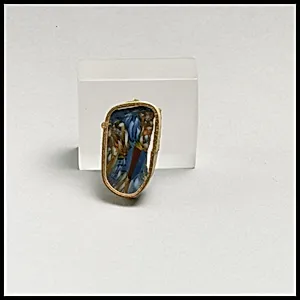
Glass mosaic bowl fragment
Unknown Artist
late 1st century BCE–early 1st century CE
Medium
Glass
Dimensions
Other: 1 1/16 x 9/16 in. (2.6 x 1.4 cm)
Classification
Glass
Culture & Period
Roman · Early Imperial
Department
Greek and Roman Art
Museum
Metropolitan Museum of Art, New York, NY
Credit
Edward C. Moore Collection, Bequest of Edward C. Moore, 1891
Accession Number
91.1.1980
Rights
Public Domain
Art Historical Context
This delicate glass mosaic bowl fragment, to the late 1st century BCE through the early 1st CE, offers a glimpse into the opulent world of Early Imperial Rome. Crafted during the transition from Republic to Empire under Augustus, it exemplifies the technical prowess of Roman glassmakers who drew inspiration from Hellenistic innovations. Though only a small piece measuring 1 1/16 x 9/16 inches (2.6 x 1.4 cm), it once formed part of a luxurious vessel used by the elite for dining or display. Roman mosaic glass, a hallmark of this era, involved bundling thin rods—or canes—of colored glass, fusing them into patterned slabs, and slicing them into sections for bowls and cups. This labor-intensive technique created vibrant, intricate designs resembling stone mosaics but in translucent form, allowing light to dance through the colors. Such vessels were prized status symbols, traded across the Mediterranean, and highlight Rome's mastery of glassblowing and millefiori-like patterns just before the widespread adoption of free-blown glass around 50 CE. Now housed in the Metropolitan Museum of Art's Greek and Roman Art Department, this fragment entered the collection via the Edward C. Moore bequest in 1891. It reminds us how everyday luxuries reflected imperial ambition and artistic ingenuity, bridging ancient craftsmanship with modern appreciation.