
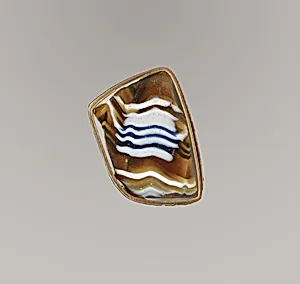
Glass mosaic ribbed bowl fragment
Unknown Artist
late 1st century BCE–early 1st century CE
Medium
Glass
Dimensions
Other: 1 1/8 x 1 11/16 in. (2.8 x 4.2 cm)
Classification
Glass
Culture & Period
Roman · Early Imperial
Department
Greek and Roman Art
Museum
Metropolitan Museum of Art, New York, NY
Credit
Edward C. Moore Collection, Bequest of Edward C. Moore, 1891
Accession Number
91.1.1762
Rights
Public Domain
Art Historical Context
This delicate fragment from a glass mosaic ribbed bowl hails from the Early Imperial Roman period, spanning the late 1st century BCE to the early 1st century CE. Crafted during the transition from Republic to Empire under Augustus, it exemplifies the opulence of Roman luxury goods. Though only a small piece measuring 1 1/8 x 1 11/16 inches survives, it once belonged to a finely ribbed bowl, likely used for dining or display among the elite. Roman glassmakers mastered mosaic techniques, slicing and fusing colorful glass canes—rods of glass in vibrant hues like blues, whites, and reds—into intricate patterns before slumping them over molds. The ribs added both structural elegance and a tactile appeal, catching light to mimic more precious materials like marble or gemstones. This advanced method, rooted in earlier Hellenistic traditions, highlights Rome's technological prowess and trade networks spanning the Mediterranean. As part of the Metropolitan Museum of Art's Greek and Roman Art collection, gifted through the Edward C. Moore bequest in 1891, this fragment offers a glimpse into everyday extravagance. Such vessels were status symbols, blending functionality with artistry, and their rarity today underscores the fragility of ancient glass.