
Glass perfume bottle
Unknown Artist
1st century CE
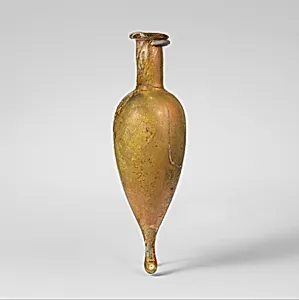
Medium
Glass
Dimensions
4 1/2 in. (11.5 cm) Other: 1 3/8 in. (3.5 cm) Diam. of rim: 3/4 in. (2 cm)
Classification
Glass
Culture & Period
Roman · Early Imperial
Department
Greek and Roman Art
Museum
Metropolitan Museum of Art, New York, NY
Credit
The Cesnola Collection, Purchased by subscription, 1874–76
Accession Number
74.51.27
Rights
Public Domain
Art Historical Context
This delicate glass perfume bottle, dating to the 1st century CE during Rome's Early Imperial period, the everyday elegance of Roman craftsmanship. Standing just 4½ inches (11.5 cm) tall with a slender body, narrow neck, and rim diameter of ¾ inch (2 cm), it was designed to hold precious oils or perfumes—known as unguents—used in personal grooming, religious rituals, and even funerary practices. Crafted from transparent glass, its simple, elongated form highlights the Roman innovation in glassmaking, which made such luxury items accessible beyond the elite. Glass production flourished in the Roman Empire, with techniques like molding and early free-blowing allowing for mass production of functional yet beautiful vessels. Perfume bottles like this one were ubiquitous in households across the Mediterranean, reflecting a culture that prized hygiene, scent, and sensory indulgence as markers of refinement. Archaeological finds from sites like those in Cyprus—part of the Cesnola Collection acquired by the Metropolitan Museum of Art in 1874–76—reveal how these objects bridged utility and artistry in daily life. Today, this unassuming bottle offers a window into the tactile world of ancient Romans, reminding us how small luxuries scented their grand empire. Part of the Met's Greek and Roman Art department, it invites visitors to appreciate the ingenuity behind antiquity's most intimate artifacts.