
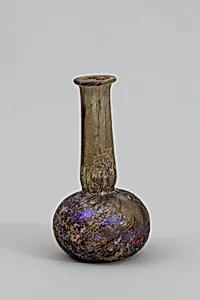
Glass perfume bottle
Unknown Artist
late 1st–3rd century CE
Medium
Glass
Dimensions
H.: 4 1/4 in. (10.8 cm)
Classification
Glass
Culture & Period
Roman · Mid Imperial
Department
Greek and Roman Art
Museum
Metropolitan Museum of Art, New York, NY
Credit
Bequest of Mary Anna Palmer Draper, 1915
Accession Number
15.43.158
Rights
Public Domain
Art Historical Context
This delicate glass perfume bottle, dating to the late 1st–3rd CE, offers a glimpse into the everyday elegance of Mid-Imperial Roman life. just 4¼ inches (10.8 cm) tall, it belongs to a class of vessels known asentaria, designed to hold precious oils, perfumes, or. Crafted by an unknown artisan, its slender form and transparency highlight the Romans' mastery of glassmaking a craft that flourished after the invention of glassblowing around the 1st century. Roman glass production reached new heights during this period, enabling mass creation of affordable yet beautiful objects that blurred the line between utility and luxury. These bottles were often mold-blown or free-blown, achieving thin walls and vibrant clarity through techniques like trail decoration or color infusion with metal oxides. Widely used in households, tombs, and rituals, they symbolized personal grooming and offerings to the gods, reflecting the empire's blend of practicality and refinement. Today, this piece graces the Metropolitan Museum of Art's Greek and Roman Art department, thanks to the 1915 bequest of Mary Anna Palmer Draper. It reminds us how fragile artifacts preserve the scents and stories of antiquity, inviting us to imagine a Roman hand once uncorking its fragrant contents.