
Bottle
2nd-3rd century
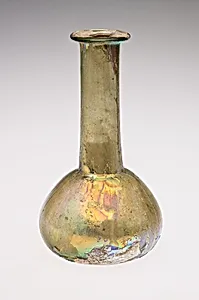
Medium
Glass, core-formed technique
Dimensions
15.1 × 8.4 × 8.4 cm (6 × 3 1/4 × 3 1/4 in.)
Classification
bottle
Department
Arts of Greece, Rome, and Byzantium
Museum
Art Institute of Chicago
Accession Number
193475
Rights
Public Domain
Art Historical Context
This delicate glass bottle, crafted by ancient Roman artisans in the 2nd-3rd century CE, exemplifies the ingenuity of early glassmaking during the height of the Roman Empire. just 6 inches tall, its compact form (15.1 × 8.4 × 8.4 cm) made it ideal for holding precious perfumes, oils, or cosmetics—luxury items traded across the Mediterranean world. Housed in the Art Institute of Chicago's Department Arts of Greece, Rome and Byzantium, it of daily life in a bustling empire where glass vessels symbolized status and refinement. The bottle was created using the core-formed technique, a sophisticated method dating back millennia but perfected by Romans. Artisans shaped a removable core of sand or clay, then layered molten glass around it in vibrant hues, often blues, greens, or translucent whites, before cooling and extracting the core. This labor-intensive process produced smooth, elegant shapes unattainable by simpler molding, highlighting Roman innovation just before the revolutionary glassblowing era. Today, its surface may shimmer with iridescence from natural weathering, adding to its allure. As a survivor from antiquity, this bottle offers a tangible link to Roman culture, where such unguentaria graced tombs, homes, and temples. It reminds us how everyday objects carried artistic and economic weight in a global trade network, blending utility with understated beauty.
About the Artist
Ancient Roman
The artists attributed to "Ancient Roman" in museum collections represent the anonymous craftsmen who produced the vast output of sculpture, frescoes, mosaics, and reliefs defining Roman visual culture from the Republic (c. 509–27 BCE) to the late Empire (c. 395 CE). Individual identities remain elusive, as Roman makers were typically viewed as skilled tradesmen—often enslaved Greeks or provincial...