
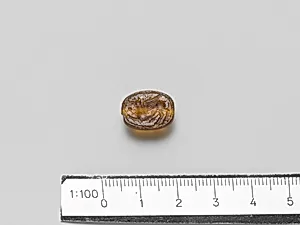
Glass scarab
Unknown Artist
4th century BCE
Medium
Glass, yellow
Dimensions
Other: 3/8 x 9/16 in. (1 x 1.4 cm)
Classification
Gems
Culture & Period
Etruscan · Late Classical
Department
Greek and Roman Art
Museum
Metropolitan Museum of Art, New York, NY
Credit
Gift of J. Pierpont Morgan, 1917
Accession Number
17.194.20
Rights
Public Domain
Tags
Art Historical Context
This delicate yellow glass scarab, in Etruria during the 4 century BCE Late Classical period, measures a mere 3/8 x 9/16 inches (1 x 1.4 cm), yet packs a punch of ancient ingenuity. As a gem from the Metropolitan Museum of Art's Greek and Roman Art department—gifted by J.pont Morgan in 191—it showcases the Etruscans' flair for miniature masterpieces, blending local craftsmanship with borrowed Eastern motifs. Scarabs, beetle-shaped amulets popularized in Egypt as symbols of rebirth and protection, were enthusiastically adopted by the Etruscans as seals, jewelry, or talismans. This example likely features engraved griffins—fierce mythical creatures with lion bodies and eagle heads—evoking power, guardianship, and the exotic worlds of Greek and Near Eastern mythology. The vibrant yellow glass, molded or carved with precision, reflects advanced Etruscan glassworking techniques, imitating precious stones like chalcedony while making luxury accessible. A testament to cultural exchange in pre-Roman Italy, this scarab whispers of Etruscan vitality before their absorption into the Roman world, inviting us to marvel at how tiny objects carried big stories of belief and artistry.