
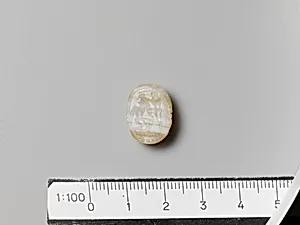
Banded agate scarab
Unknown Artist
late 6th century BCE
Medium
Agate
Dimensions
H.: 9/16 x 7/16 in. (1.4 x 1.1 cm)
Classification
Gems
Culture & Period
Etruscan · Archaic
Department
Greek and Roman Art
Museum
Metropolitan Museum of Art, New York, NY
Credit
Gift of James J. Rorimer, 1951
Accession Number
51.43.1
Rights
Public Domain
Tags
Art Historical Context
This exquisite banded agate scarab carved in the late 6th BCE during the Etruscan Archaic period exemplifies the masterful gem-cutting traditions of ancient Etruria. Measuring just 9/16 x 7/16 inches (1.4 x 1.1 cm), this beetle-shaped seal showcases the Etruscans' skill in transforming durable, translucent agate—a semi-precious stone prized for striking banded patterns—into a functional work of art. The medium's natural veining likely enhanced the scarab's lifelike form, making it both a practical seal for impressing wax or clay on documents and a possible amulet symbolizing rebirth and protection, motifs borrowed from Egyptian influences via Greek trade. Etruscan artisans, thriving in central Italy before Roman dominance, blended local ingenuity with Mediterranean inspirations, as seen in this scarab's form. Such gems were status symbols for elites, worn as jewelry or carried for everyday use, reflecting a vibrant culture of commerce, ritual, and artistry. Donated to the Metropolitan Museum of Art in 1951 by James J. Rorimer, this piece now invites us to marvel at the precision required to carve such intricate details on a scale smaller than a modern fingernail. Today, it highlights the interconnected ancient world, where a humble scarab bridged cultures across the Mediterranean.