
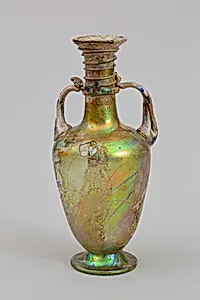
Glass two-handled bottle
Unknown Artist
ca. 4th century CE
Medium
Glass
Dimensions
Diam.: 7 1/4 in. (18.4 cm)
Classification
Glass
Culture & Period
Roman · Late Imperial
Department
Greek and Roman Art
Museum
Metropolitan Museum of Art, New York, NY
Credit
Bequest of Mary Anna Palmer Draper, 1915
Accession Number
15.43.170
Rights
Public Domain
Art Historical Context
This elegant glass two-handled bottle, dating to around the 4th century, hails from the Late Imperial Roman period and exemplifies the artistry of Roman glassmakers. Standing with a diameter of 7¼ inches (18.4 cm), its symmetrical form with practical twin handles suggests it was designed for pouring liquids like oils, perfumes, or—common in Roman households and banquets. Crafted by an unknown artisan, it reflects the widespread accessibility of glass vessels by this era, transforming what was once a luxury into an everyday staple. Roman glass production reached new heights in the Late Imperial period, fueled by innovations like glassblowing introduced centuries earlier. This technique allowed for thin-walled, lightweight forms like this bottle, often molded or tooled for handles and decorative flair. Such pieces highlight Rome's vast trade networks, with raw materials and finished goods circulating across the empire from workshops in the eastern Mediterranean. Bequeathed to the Metropolitan Museum of Art in 1915 by Mary Anna Palmer Draper, this bottle offers a tangible glimpse into daily Roman life. Its preservation underscores glass's durability despite its fragility, inviting us to imagine it gracing a villa table amid the empire's twilight. A testament to functional beauty, it bridges utility and subtle sophistication in ancient craftsmanship.